Anonymous visitor
Private from the first screen
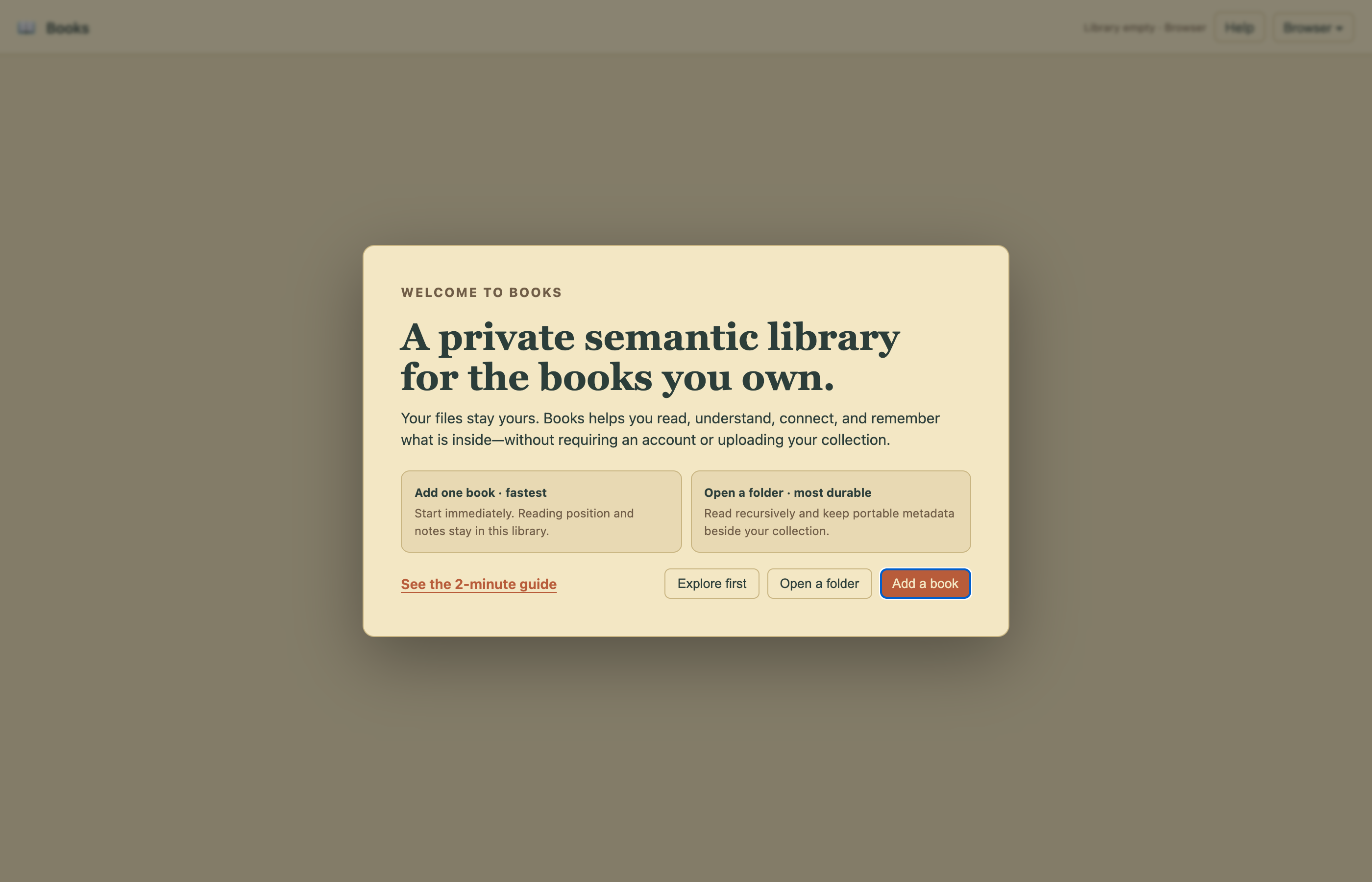
Lorewell has no account gate: an anonymous visitor starts with a local, empty library and a clear statement of what stays on this device.
Lorewell · visual product guide
The modern take is not “Calibre in a browser.” Lorewell helps you read, understand, connect, and remember what is inside—without taking ownership away from you.
Try “AI”, “notes”, “storage”, “Native”, or a reader context.
01
Lorewell is useful before sign-in because there is no sign-in. The browser is the private boundary.
Anonymous visitor
Lorewell has no account gate: an anonymous visitor starts with a local, empty library and a clear statement of what stays on this device.
02
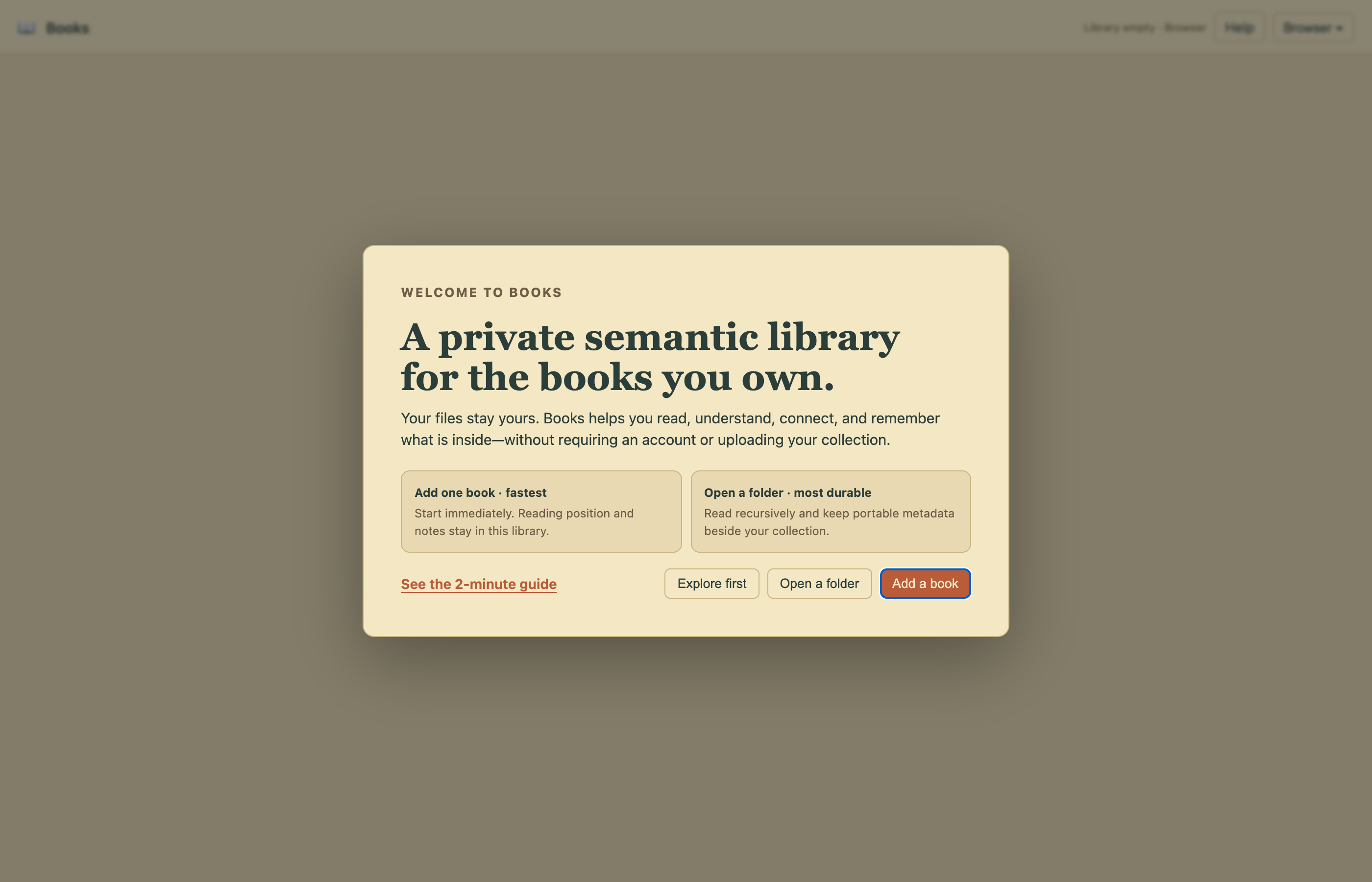
The first-run path explains both the fastest start and the more durable folder-backed library.
Brand-new reader
Start with individual files, drag-and-drop, or grant a folder so Lorewell can discover supported formats recursively.
Brand-new reader
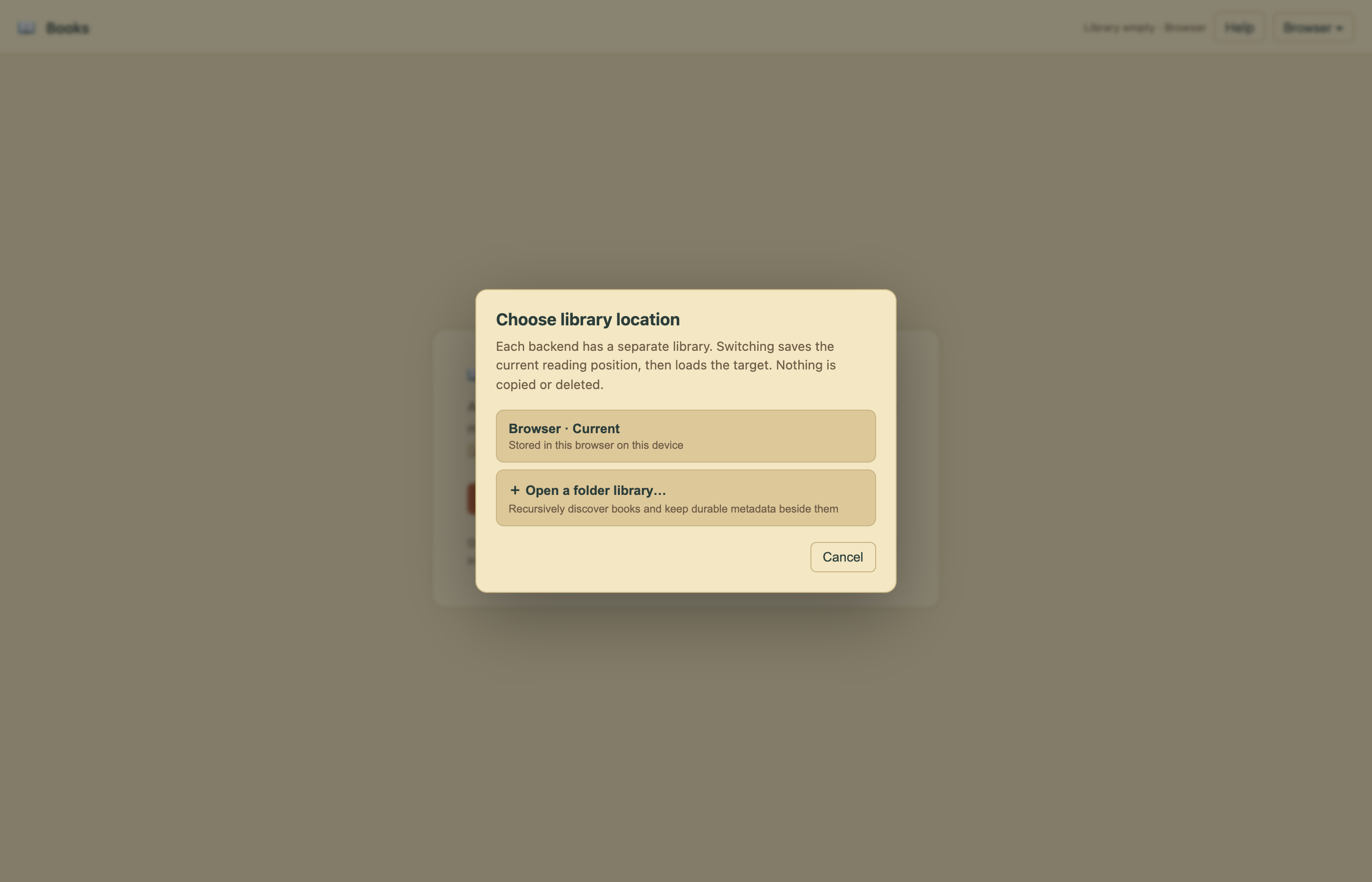
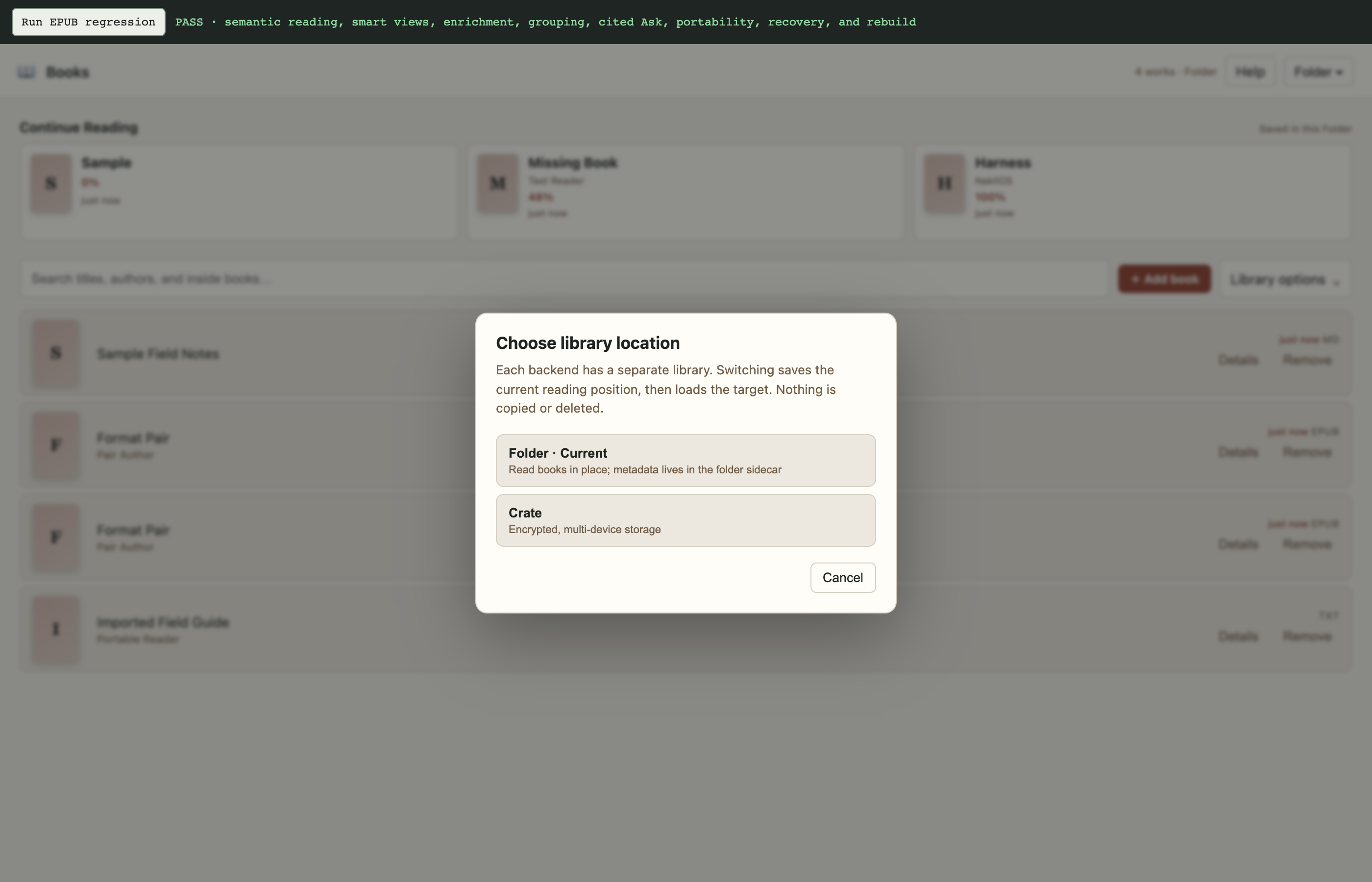
Browser storage, a durable Folder sidecar, and NakliOS storage remain explicit, isolated libraries—switching never silently copies or deletes.
03
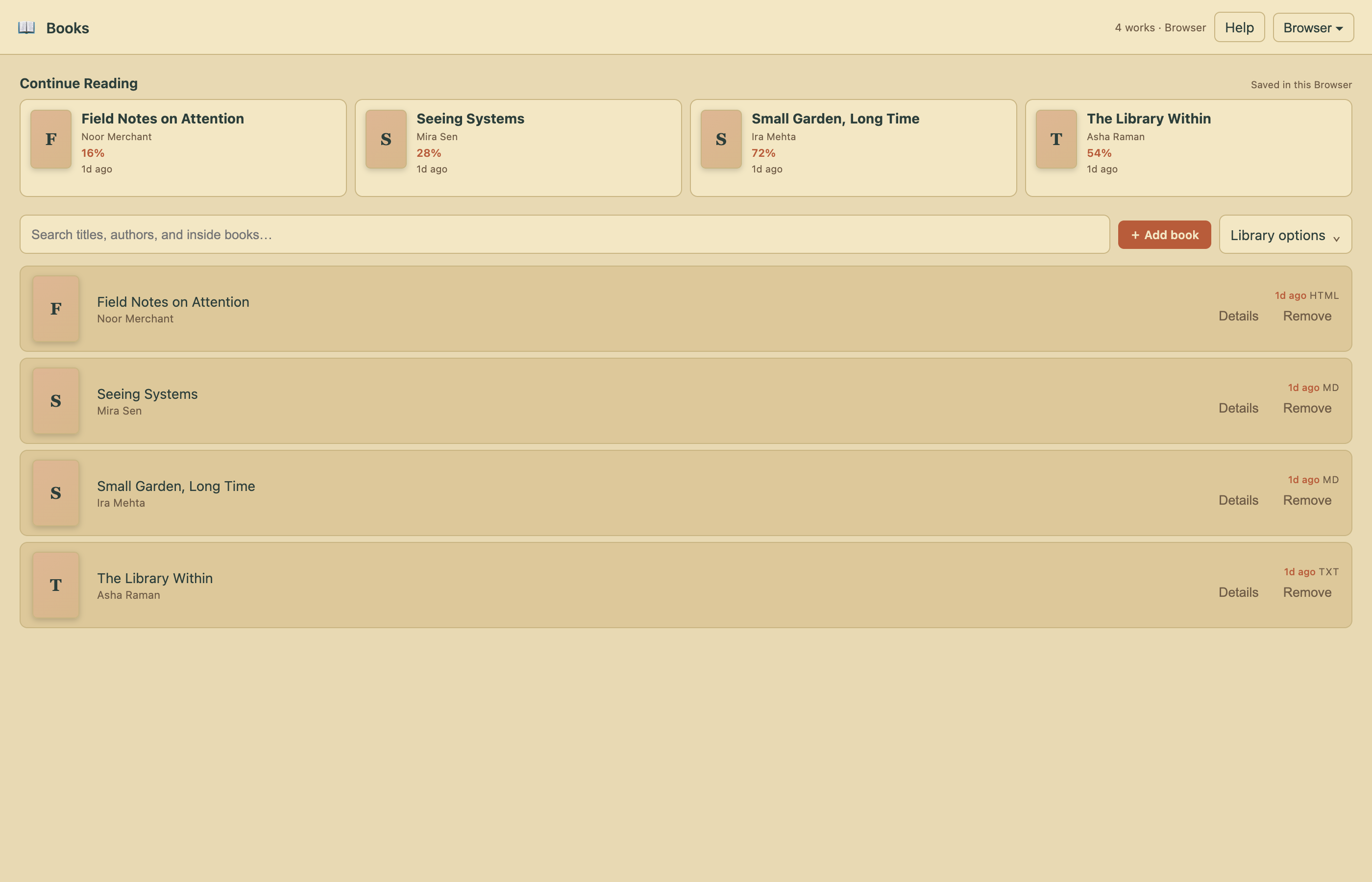
Once populated, the collection becomes an active private knowledge space rather than a grid of inert files.
Library owner
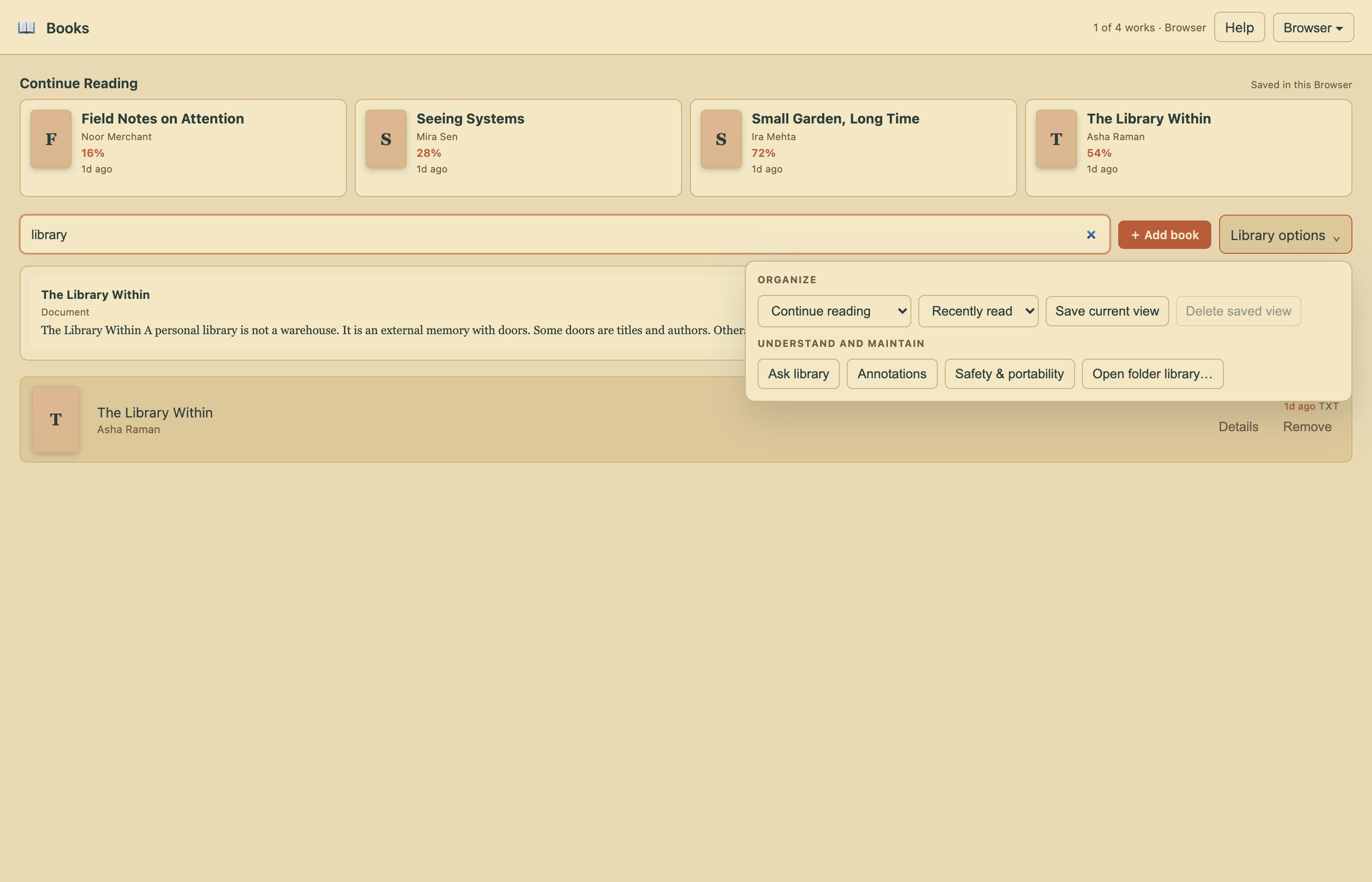
Continue Reading, one search, and Add lead; saved views and library-wide maintenance stay one deliberate step away.
Library owner
Combine reading state, shelves, tags, text filtering, and sort order, then save that view inside the active library.
Library owner
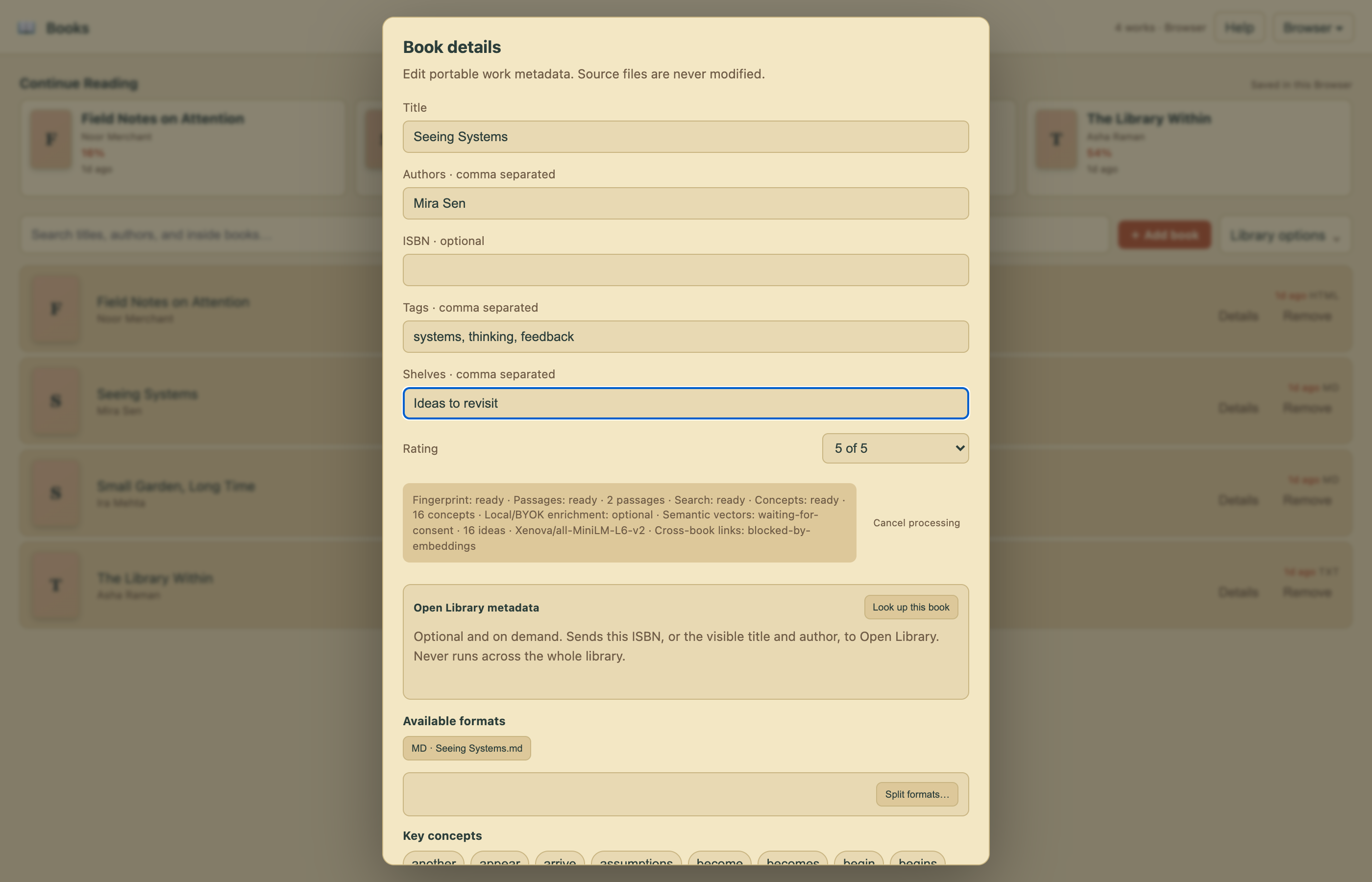
Edit title, authors, ISBN, tags, shelves, rating, formats, concepts, and processing state without modifying the original book.
Library owner
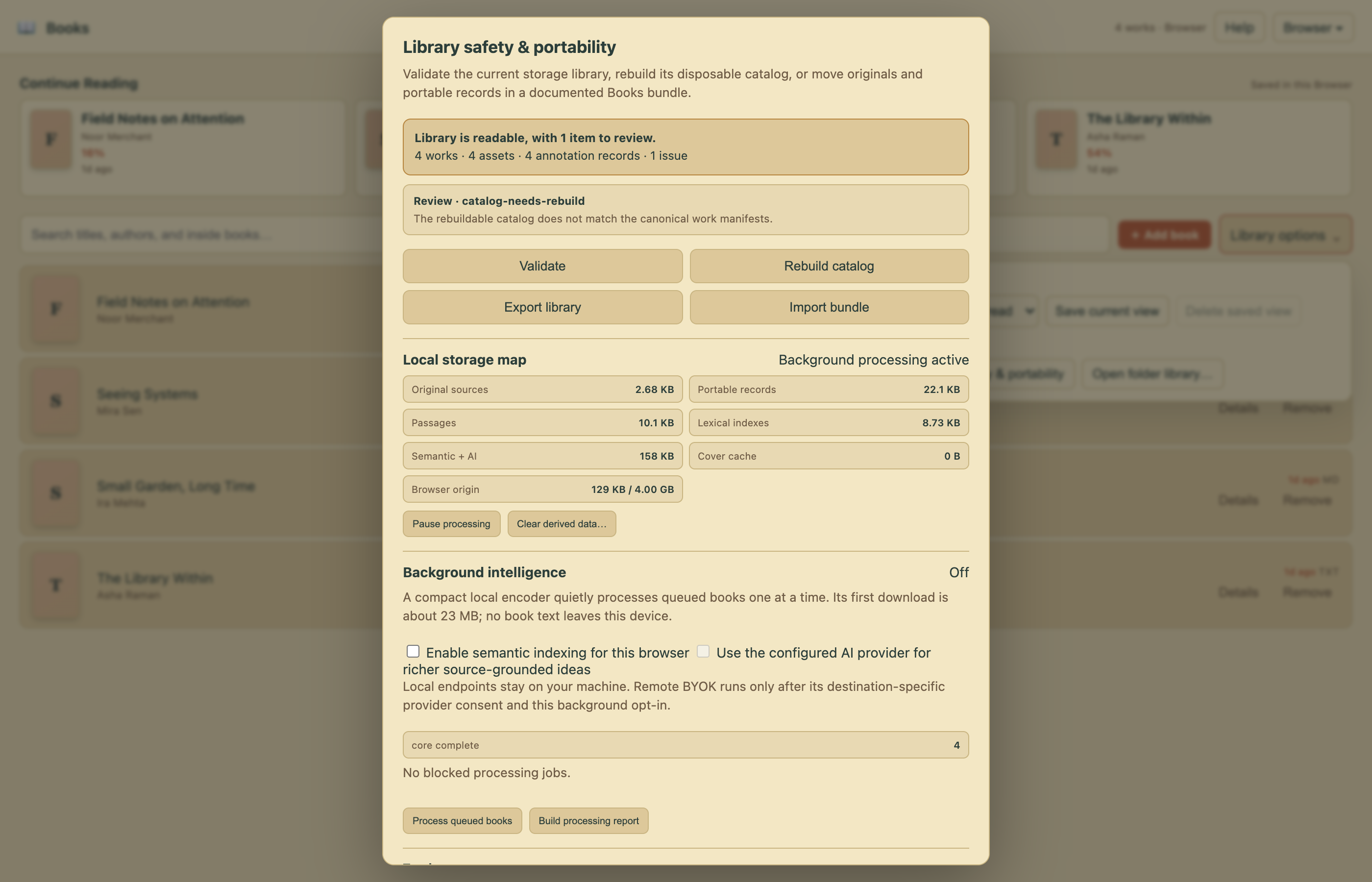
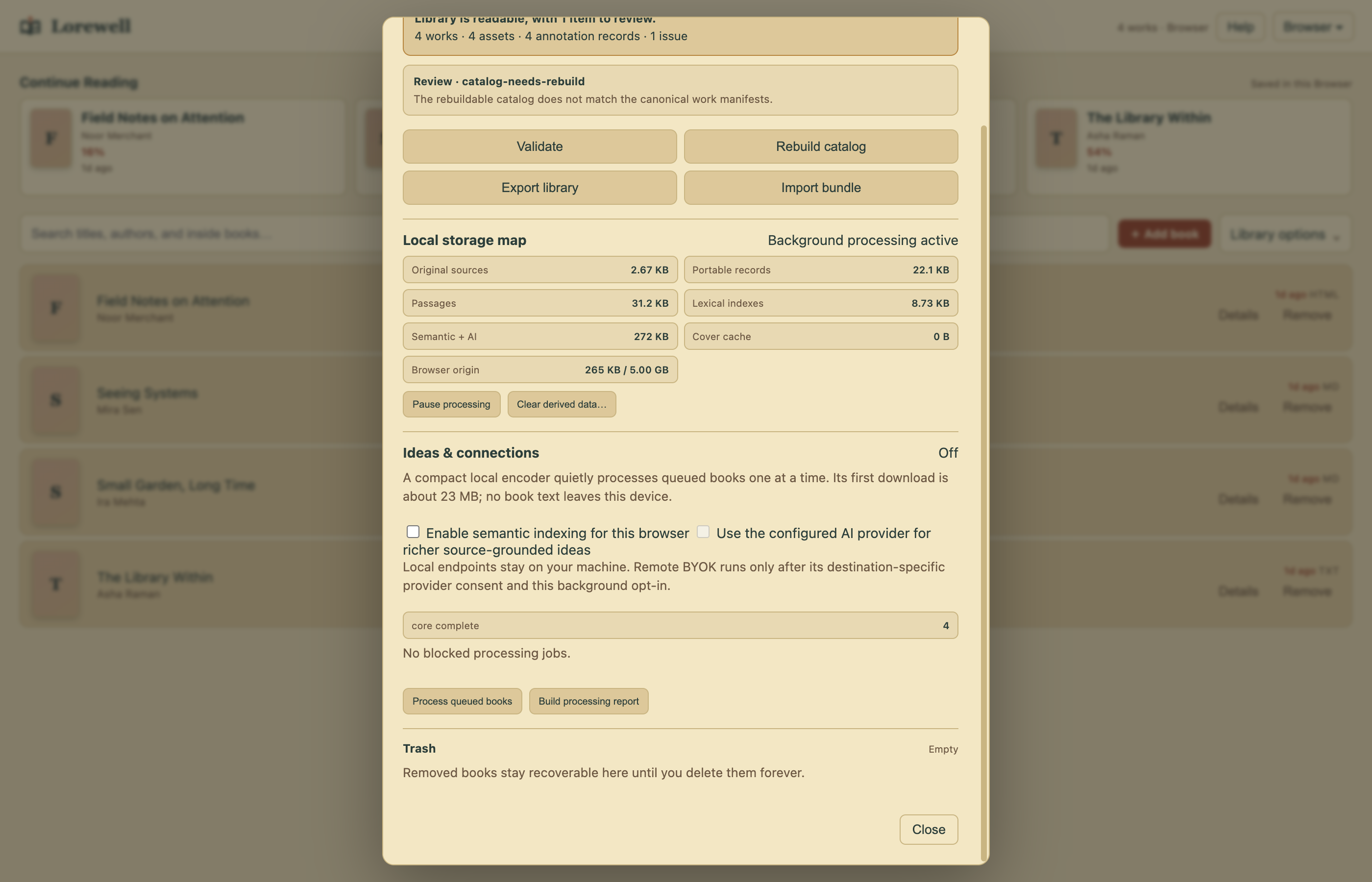
Validate canonical records, rebuild disposable indexes, export a portable library, inspect background work, and recover books from Trash.
Library owner
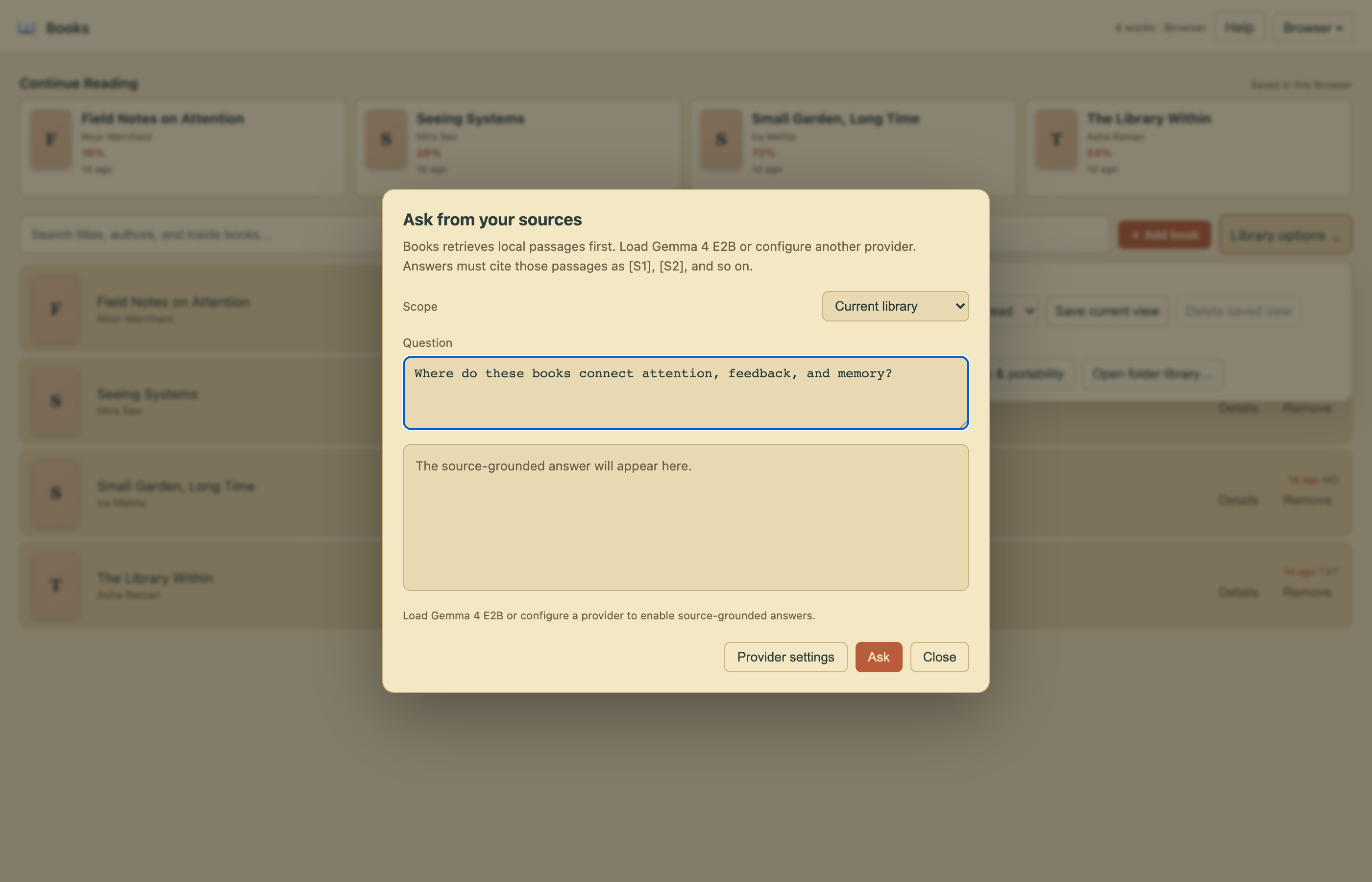
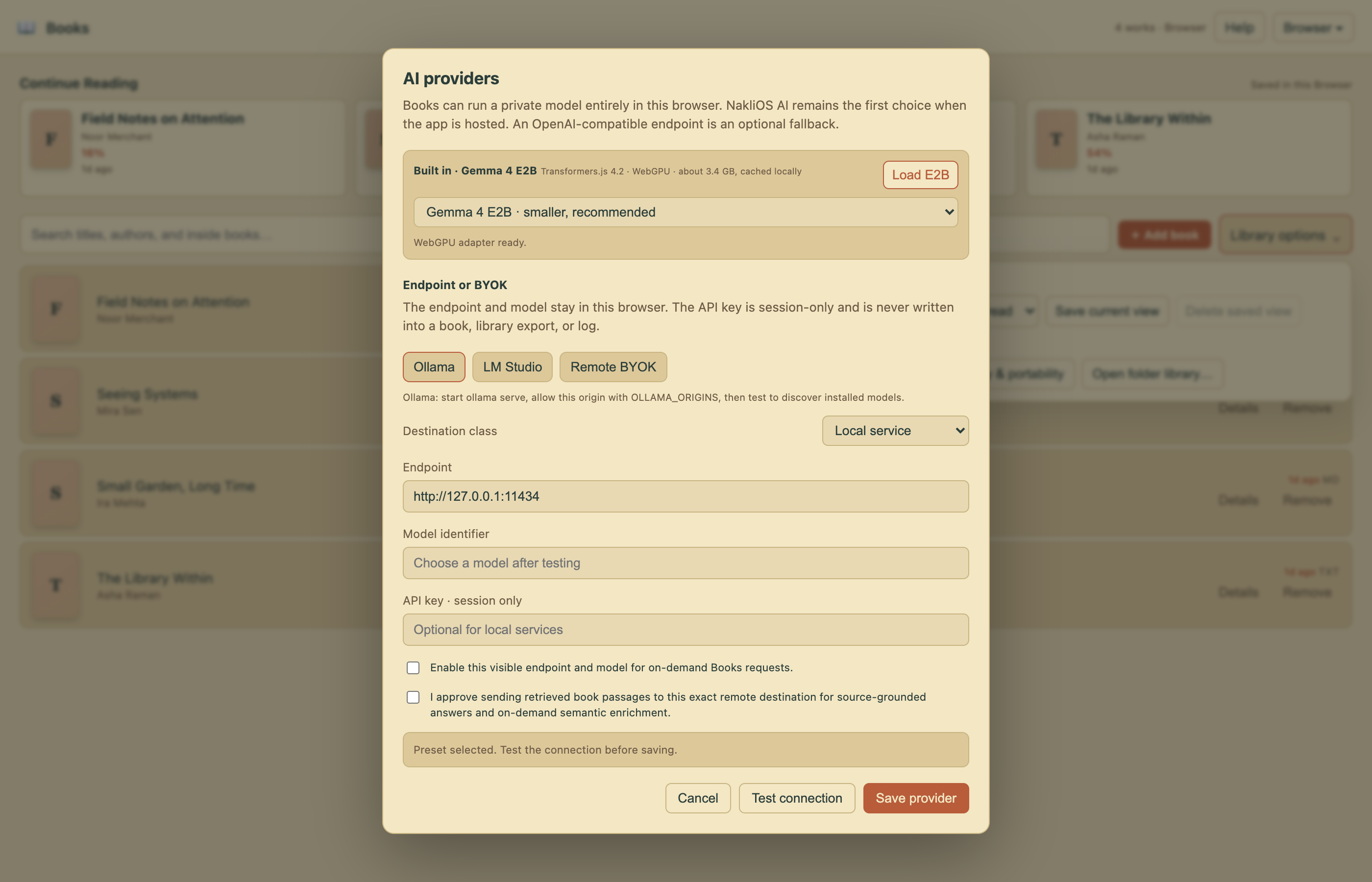
Lorewell retrieves passages locally first and requires the answer to cite the exact excerpts supplied to the chosen provider.
Library owner
Use the built-in on-device model, Ollama, LM Studio, or an explicit remote endpoint with session-only keys and destination-specific consent.
Library owner
Opt into local semantic indexing, inspect each queued book, and add richer provider-assisted concepts only when you choose; originals and authored metadata remain independent.
Library owner
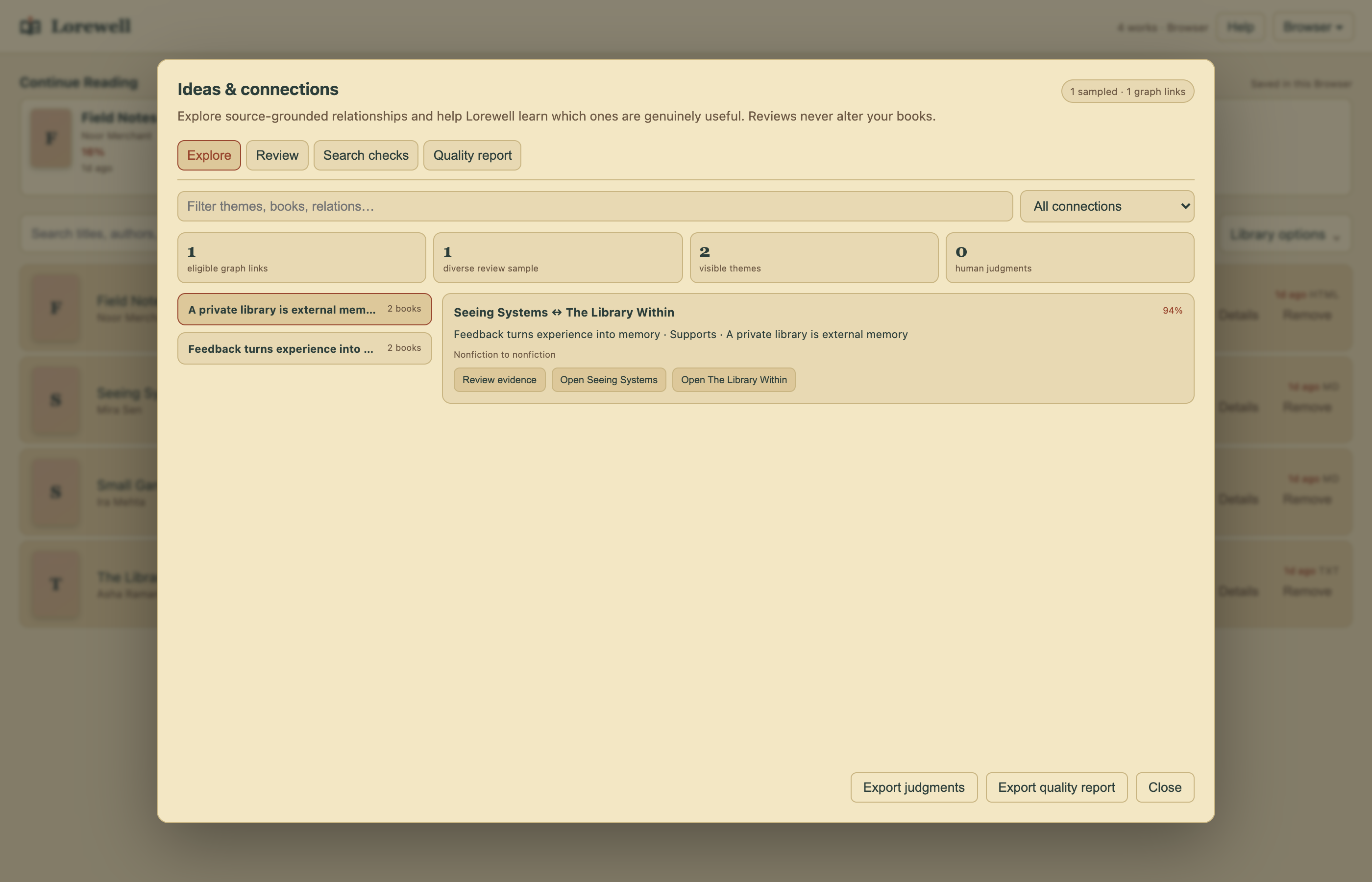
Ideas & connections ranks recurring themes by the books and grounded links they touch, then lets you inspect the evidence trail or open either source without leaving the private library.
Library owner
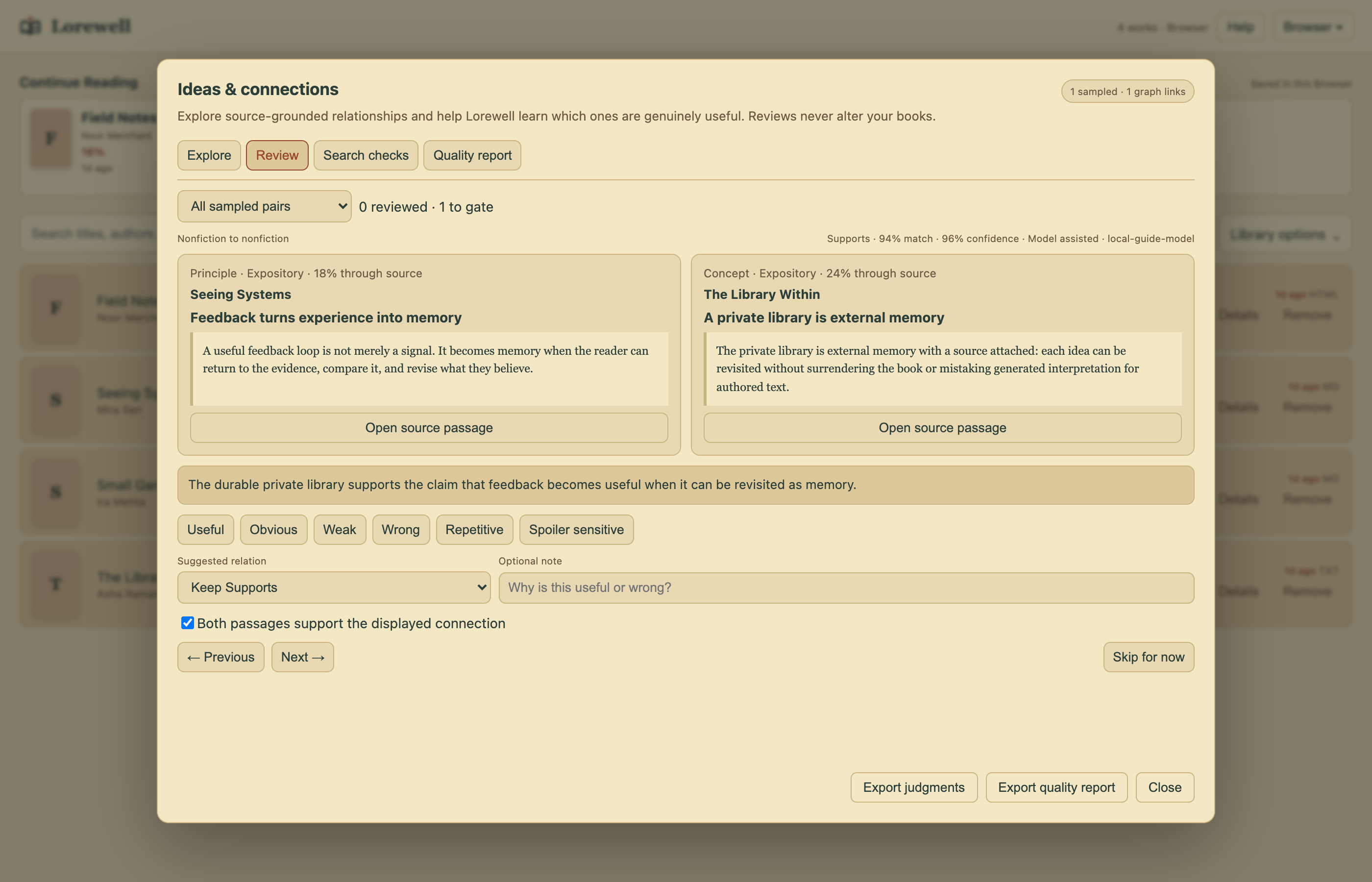
A resumable, stratified review queue places both excerpts side by side with relation, confidence, spoiler risk, provenance, and durable judgments; thresholds remain advisory until a human approves rollout.
04
The reading surfaces keep source fidelity, personal memory, reflow, and optional assistance in one continuous workspace.
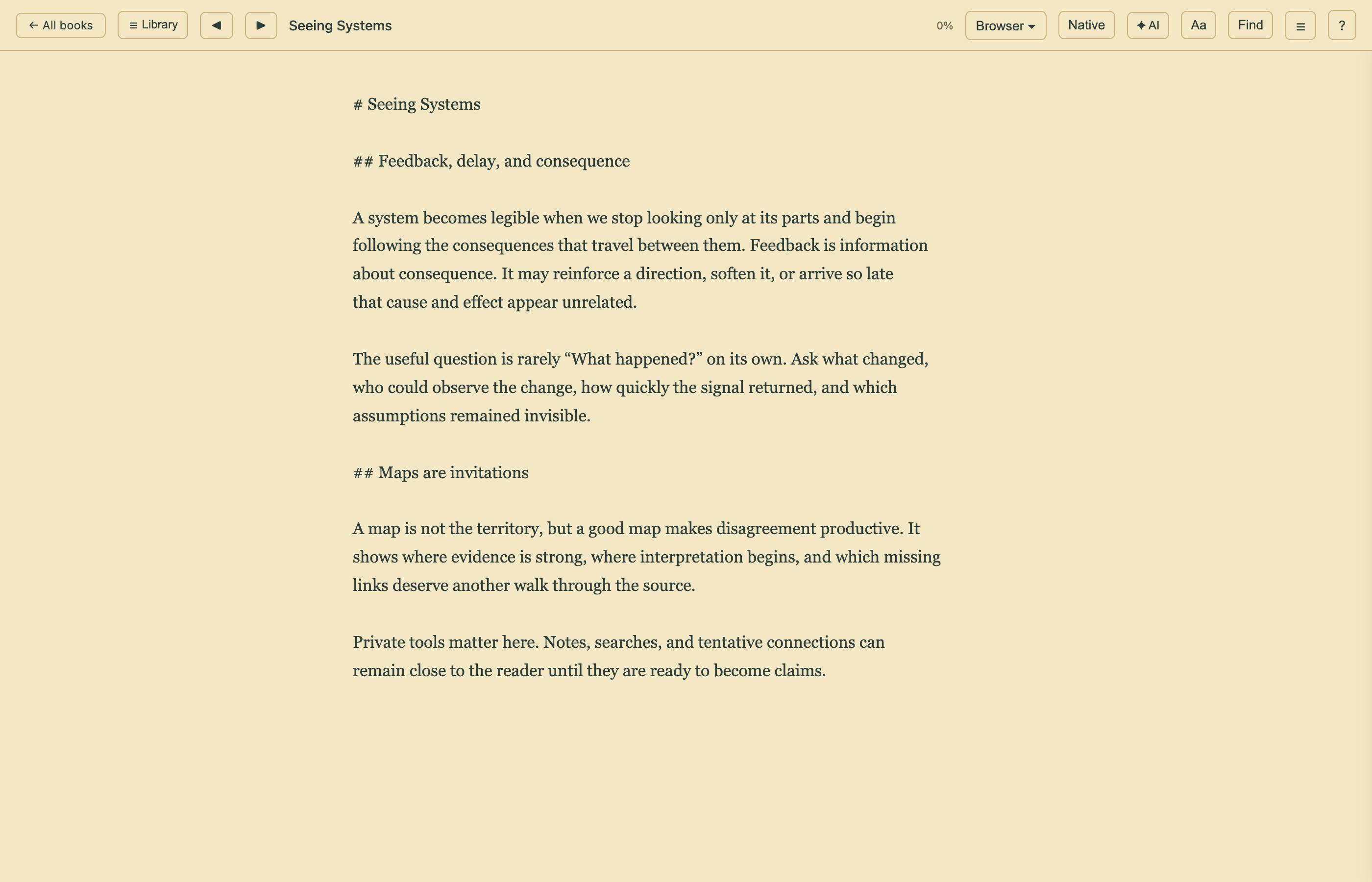
Active reader
The primary reader preserves the book’s own structure on a full canvas while keeping the library available from the top bar.
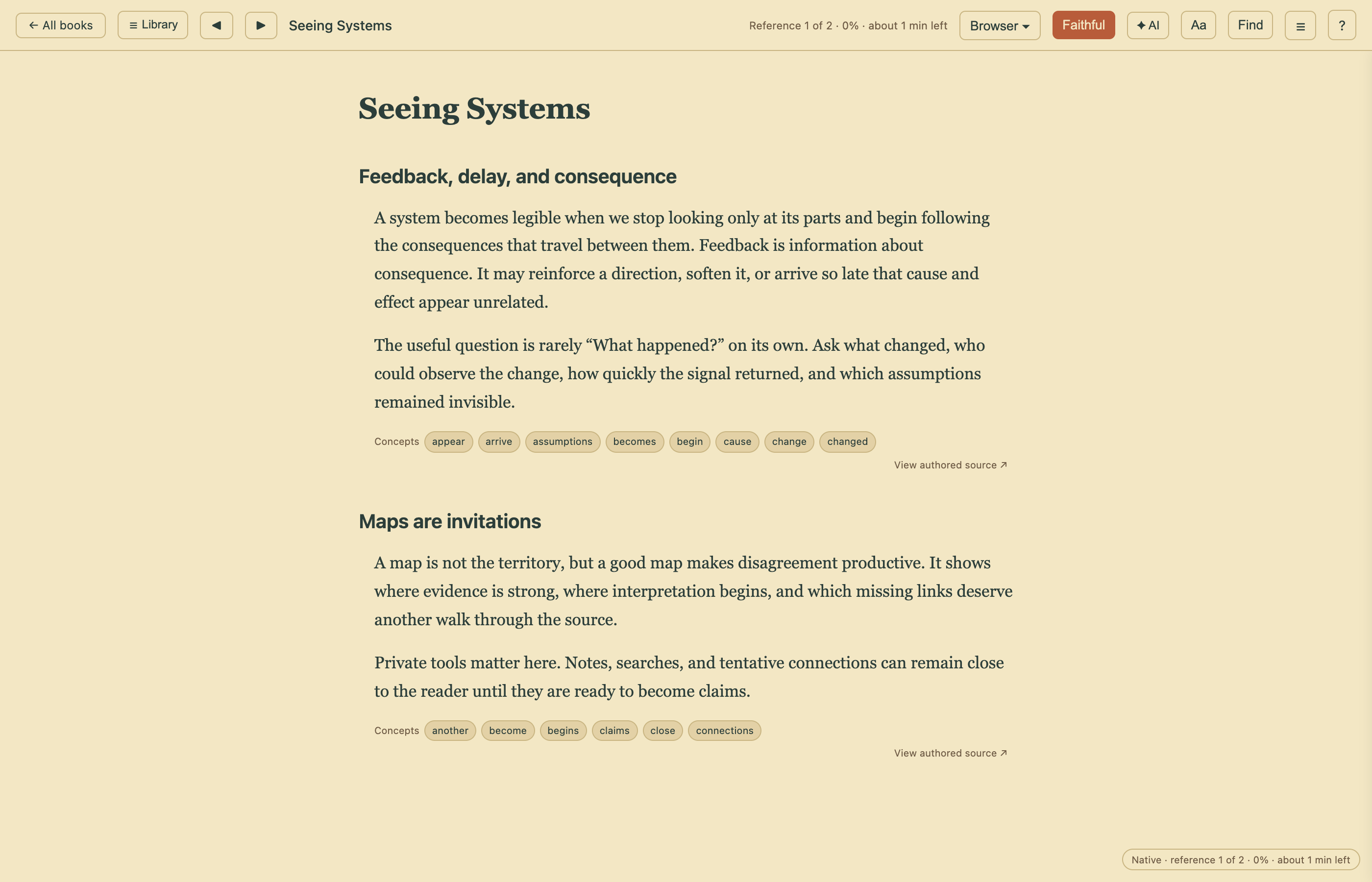
Active reader
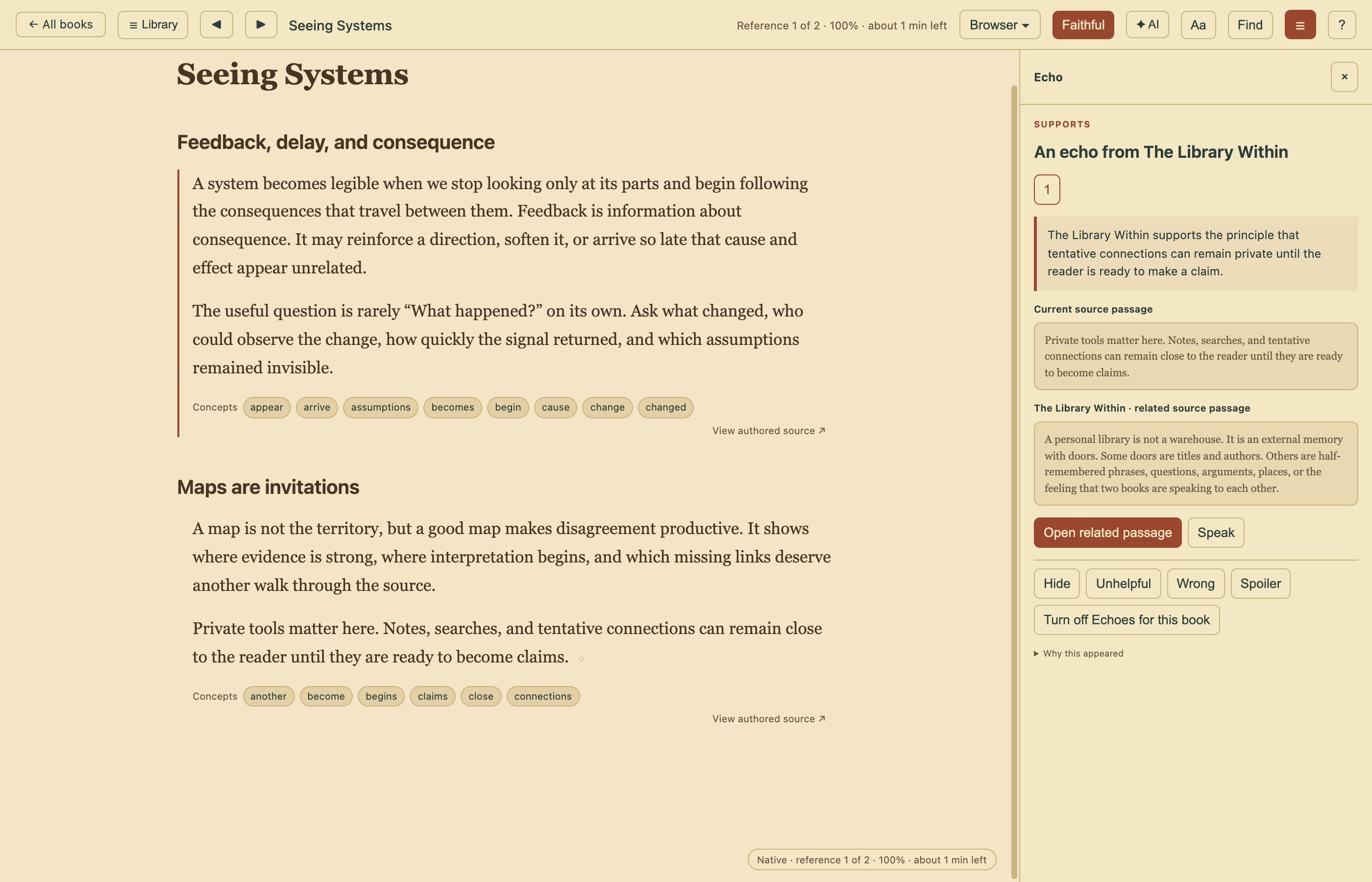
Native mode reflows indexed passages into an accessible reading surface with stable references and source-grounded concepts. A quiet optional Echo indicator can reveal grounded connections to another book, conceal spoilers, speak on request, open the exact related paragraph, and return you here.
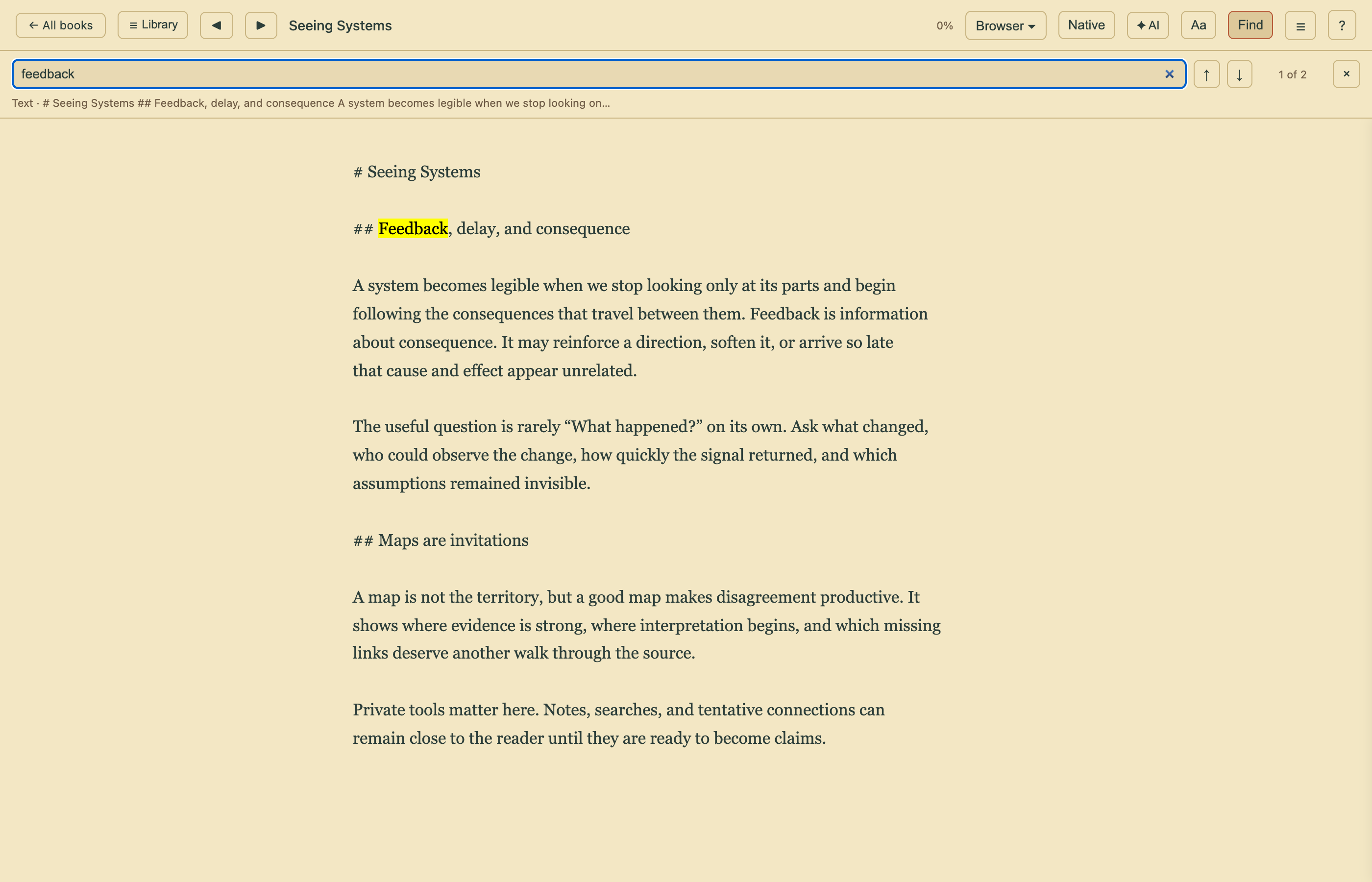
Active reader
Find in book uses engine-aware anchors for EPUB, PDF, and reflowable text while retaining a common keyboard and result interface.
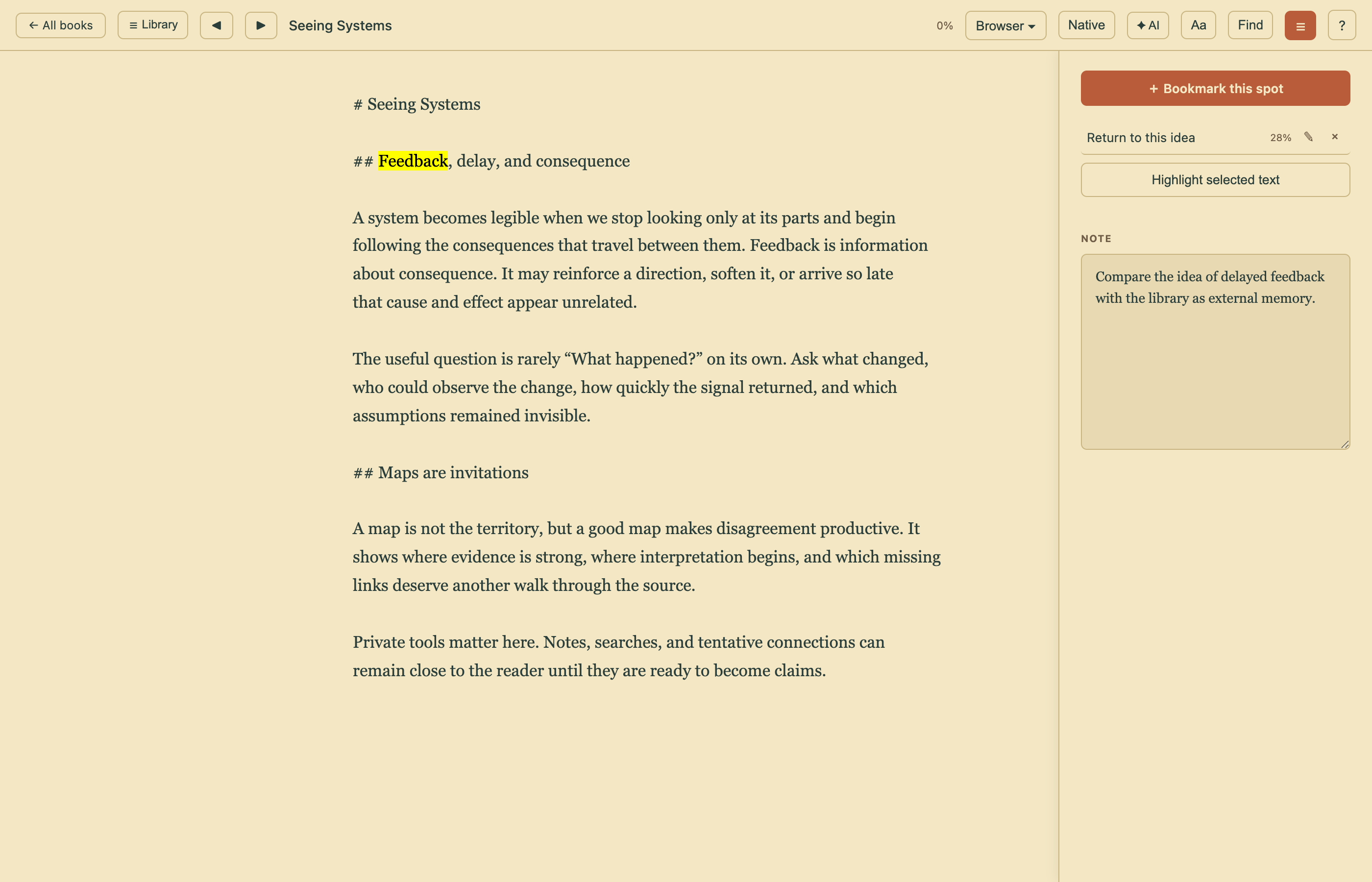
Active reader
Bookmarks, portable highlights, a table of contents, and per-book notes stay attached to the source and survive derived-index rebuilds.
Active reader
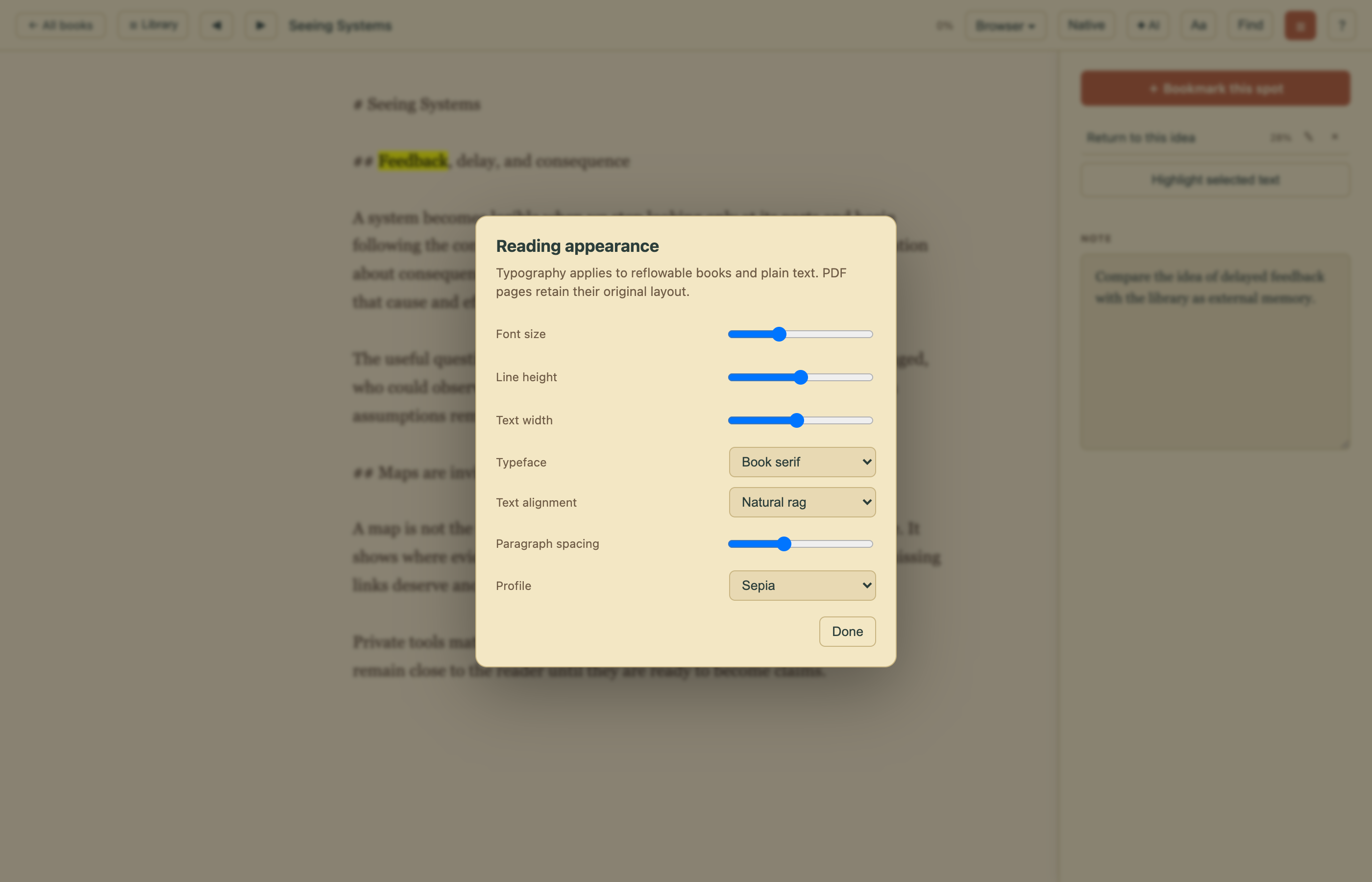
Adjust typeface, size, rhythm, width, alignment, spacing, and colour profile without changing the book itself.
Active reader
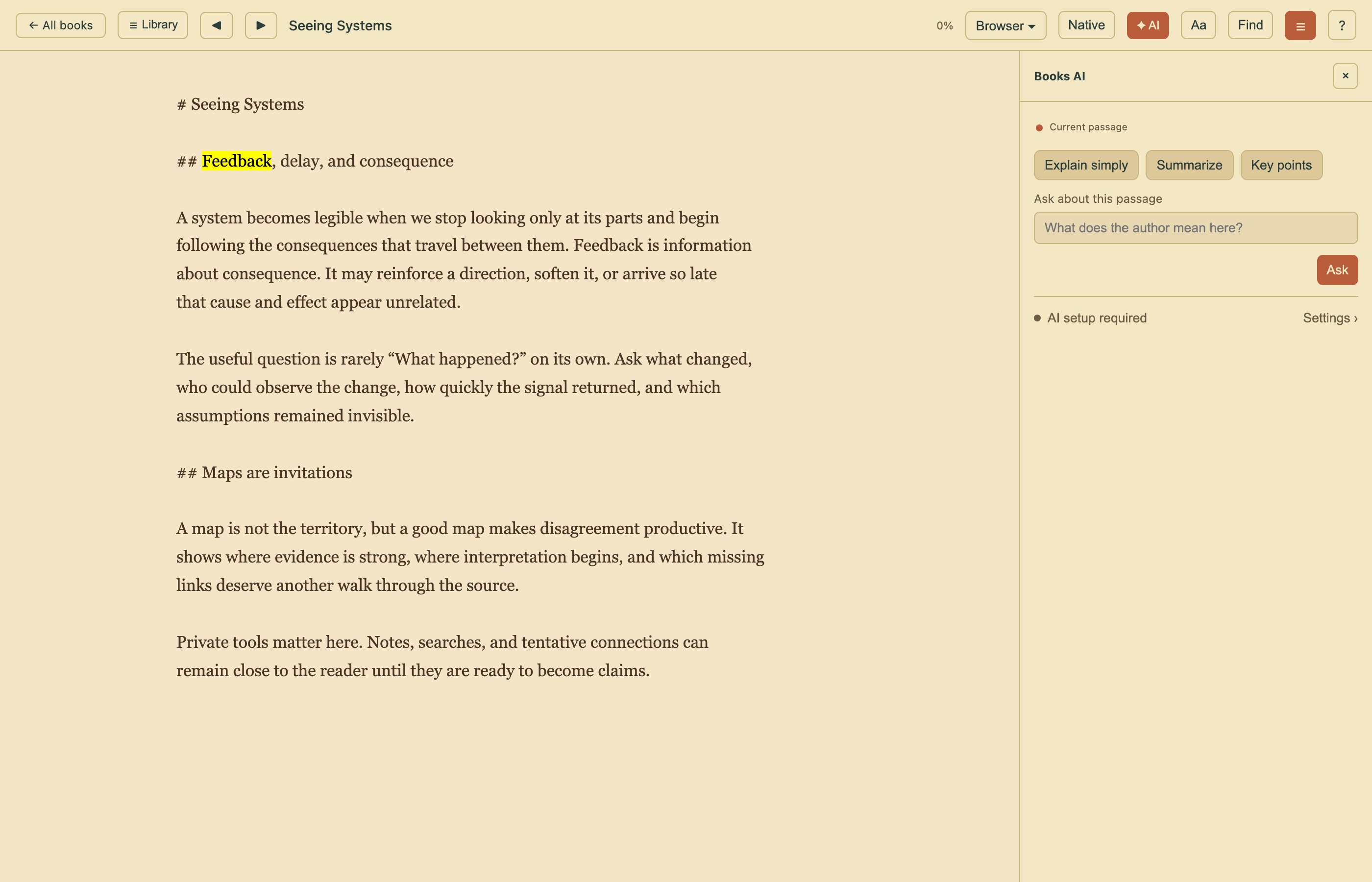
Explain, summarize, extract key points, or ask a question about the current passage without turning AI into a blocking reader modal.
Active reader
A discreet paragraph indicator opens an evidence card with both source excerpts, relationship direction, spoiler controls, feedback, and an exact route into the related work.
05
Inside NakliOS, Lorewell adopts host capabilities without losing the standalone product or crossing storage boundaries.
NakliOS reader
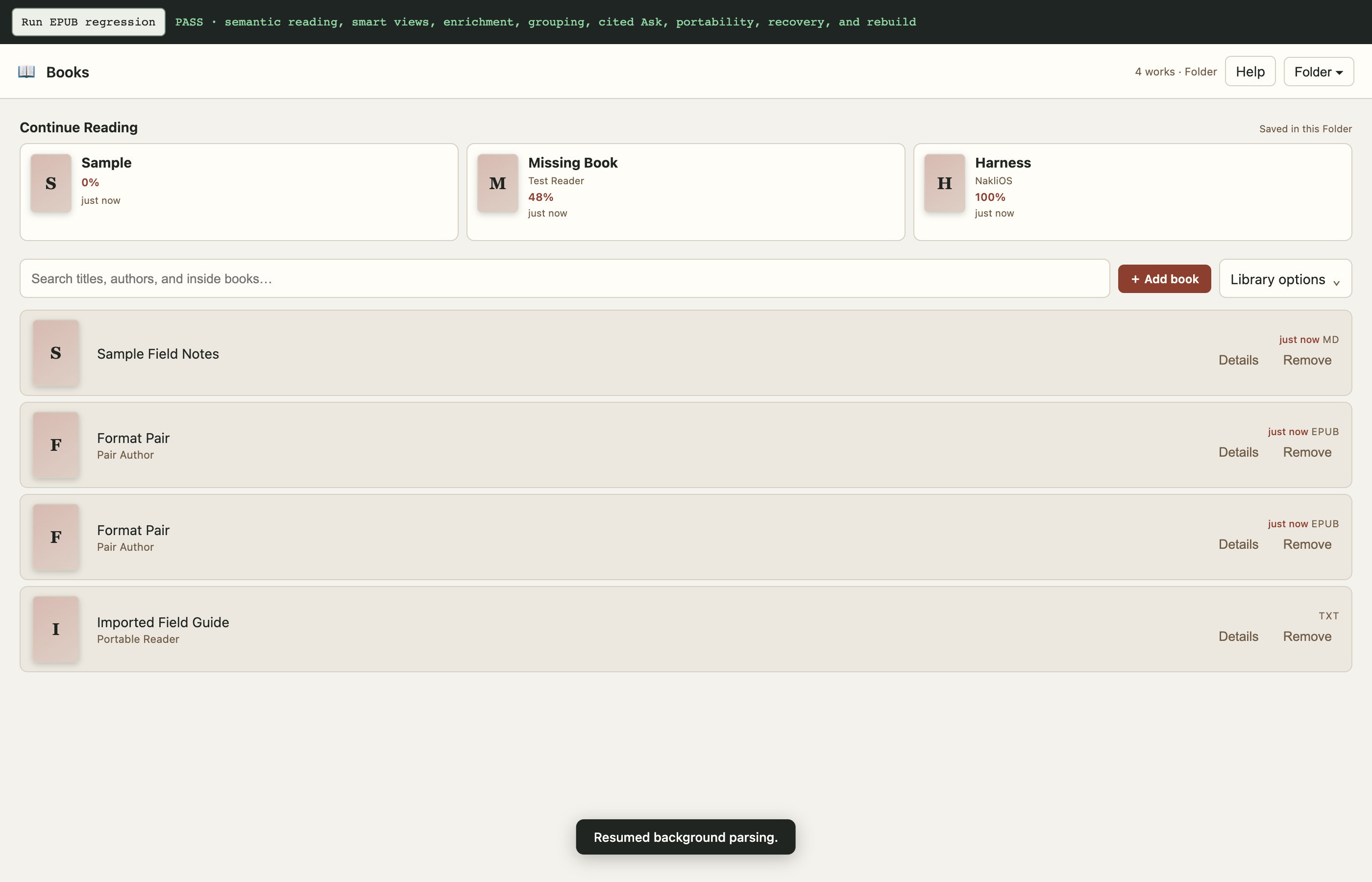
Lorewell keeps its standalone reading model when hosted, while storage, theme, and AI capabilities arrive through the NakliOS boundary.
NakliOS reader
Hosted readers can switch between connected backends after pending reading state is saved; neither library is merged implicitly.